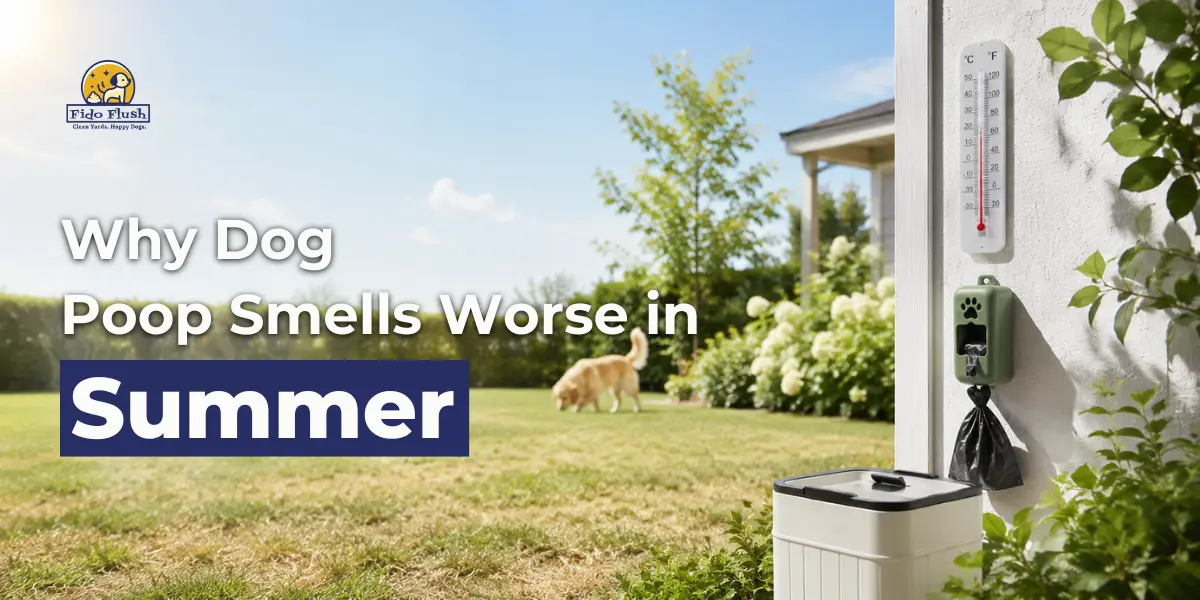
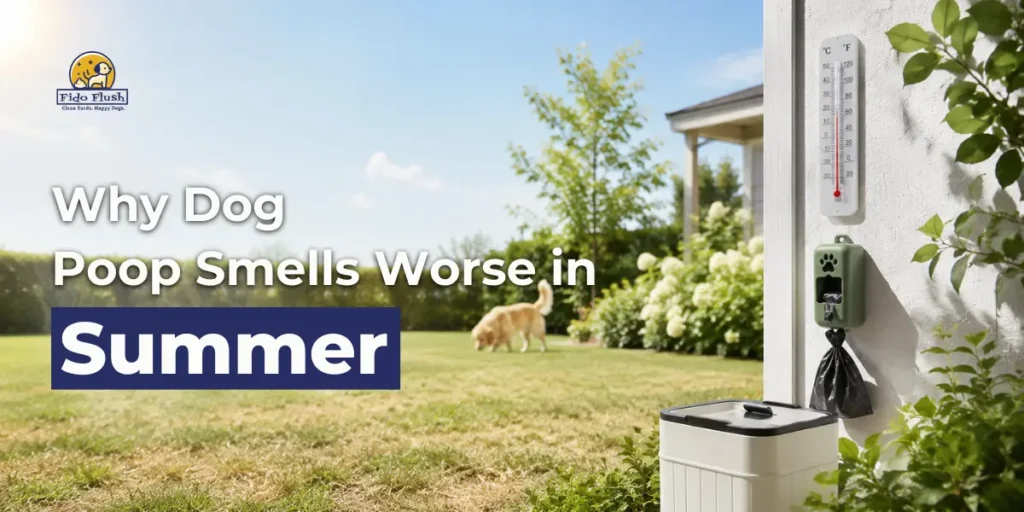
If your yard has ever gone from tolerable to unpleasant overnight as summer hits, you are not imagining it. Dog poop smells worse in summer, noticeably and consistently, and there are specific biological and environmental reasons for it. Understanding what is actually happening makes it easier to stay on top of it before the smell takes over your outdoor space.
This article explains the science behind summer poop odor, why it hits harder in warmer climates like Southern California, and what you can do about it.
Why Heat Makes Dog Poop Smells Worse
Dog feces contains a mix of bacteria, undigested food matter, intestinal cells, and water. The smell comes primarily from volatile organic compounds (VOCs) produced as bacteria break down this material. These compounds include hydrogen sulfide, ammonia, skatole, indole, and short-chain fatty acids, each contributing to the overall odor profile.
Temperature directly controls how fast those bacteria multiply and work. Bacterial activity roughly doubles with every 10 degree Celsius (18 degree Fahrenheit) increase in temperature, a principle known in microbiology as the Q10 effect. What that means practically: waste sitting in 90-degree summer heat is decomposing and off-gassing significantly faster than the same waste in 60-degree spring weather. The bacteria are not different, they are just operating at full speed.
Warmer temperatures also increase how quickly VOCs evaporate into the surrounding air. Odor compounds that might sit relatively contained in cool weather become airborne much faster in heat, which is why the smell hits you from across the yard rather than only up close.
Humidity and Moisture Lock Odor In
Heat is the accelerator, but humidity is the amplifier. In humid conditions, odor molecules stay suspended in the air longer rather than dispersing. This is why the same yard that smells manageable on a dry afternoon can feel suffocating on a muggy morning.
Even in drier climates like Los Angeles, summer mornings bring dew. That brief moisture is enough to reactivate bacteria in waste that may have partially dried, temporarily intensifying the smell before the day heats up. This is the window most dog owners notice it most: first thing in the morning when they let the dog out, before the afternoon sun dries everything back down.
Rain compounds this further. A summer shower does not clean a yard of waste residue. It softens old deposits, spreads bacteria into surrounding soil, and can push odor compounds into areas of the yard that previously smelled fine. After a rain, if your yard smells worse than before, older waste breaking down in soil is likely contributing alongside whatever is visible on the surface.
Los Angeles Summer Conditions Make It Worse
Southern California’s summer heat profile creates specific conditions that amplify this problem for local dog owners. LA averages highs between 85 and 95 degrees Fahrenheit through July and August, with many inland areas exceeding 100 degrees on peak days. At those temperatures, bacterial decomposition and VOC release are both running at maximum rate.
The combination of dry heat, direct sun on low-moisture soil, and the Santa Ana wind conditions that periodically push hot air through yards concentrates rather than disperses odor. Unlike humid coastal climates where rain washes yards regularly, LA yards can go weeks without rainfall, meaning waste residue and bacteria accumulate in soil without any natural rinse cycle.
This is specifically why a yard that seemed fine through spring becomes noticeably worse by June. Nothing changed about your dog or your cleanup routine. The ambient conditions shifted, and the chemistry followed.
Your Dog’s Diet Affects Summer Smell
The intensity of poop odor is also influenced by what your dog eats, and this becomes more noticeable in summer when decomposition is faster. Dogs eating high-protein diets produce waste richer in nitrogen-containing compounds, which produce stronger-smelling breakdown products including ammonia and amines.
Dogs on lower-quality food with more fillers tend to produce larger-volume, higher-moisture stools that decompose faster and distribute bacteria over a wider area when they break down on warm ground.
Summer can also bring dietary disruptions that worsen stool odor. Dogs spending more time outdoors are more likely to eat grass, find something in the yard they should not, or drink from outdoor water sources. Any digestive disruption changes the bacterial composition of the gut and alters the smell profile of the resulting waste. If your dog’s summer poop is smelling unusually strong even by summer standards, a dietary or digestive issue may be a contributing factor.
How Summer Odor Gets Into Your Home
One problem specific to summer that many dog owners underestimate is how yard odor migrates indoors. In winter, windows stay closed and the cold reduces bacterial activity. In summer, windows and doors are open, fans are running, and dogs are coming in and out far more frequently.
Dogs tracking bacteria and waste residue on their paws from a waste-heavy yard bring that odor inside with every trip. Summer is also when dogs spend more time rolling in the yard, returning inside with their coats carrying outdoor bacteria and the general smell of a warm, decomposing environment. If your home smells different in summer and you cannot pinpoint why, the yard and your dog’s paws are worth examining as the source.
Addressing why dogs smell after being outside during summer involves both grooming habits and the cleanliness of the outdoor environment they are spending time in.
Need a Cleaner Yard Without the Hassle?
Let Fido Flush handle the dirty work so your outdoor space stays fresh, clean, and ready to enjoy.
The Accumulation Problem
Summer is also when accumulation catches up with people. Spring cleanup habits that felt adequate, a pickup every few days, or cleaning only the obvious areas tend to fall behind as the pace of summer life picks up. Waste that accumulates over even a week in summer heat creates a significantly worse odor situation than the same accumulation in winter, because bacterial activity has had much more time at higher temperatures to process those deposits into volatile odor compounds.
The math is simple. A dog producing waste twice a day generates roughly 14 deposits per week. In summer heat, deposits from three days ago have already been through substantial bacterial processing. A yard that has not been fully cleared in two weeks has deposits at various stages of decomposition, some still intact, others partially broken down into soil, all generating odors at different rates depending on their age and exposure to sun, moisture, and temperature.
This is why getting rid of dog poop smell from a yard that has accumulated over weeks is significantly harder than preventing it from building up in the first place. Once bacterial byproducts have soaked into soil and dried grass, surface cleanup alone does not fully eliminate the odor source.
What Actually Helps
Pick up immediately. The single most effective intervention is removing waste before it has time to sit in heat. Every hour a deposit sits in summer temperatures accelerates the bacterial process producing VOCs. Same-day pickup, ideally within a few hours, makes a measurable difference in yard odor.
Focus on shade and enclosed areas. Waste in shaded corners, against fences, or under deck edges stays moist longer than waste in open sun. Moisture combined with reduced airflow means odor concentrates in those spots. These areas need more attention than open lawn areas, not less.
Do not rely on rain to clean the yard. As covered above, rain reactivates and spreads odor rather than eliminating it. Cleanup before forecasted rain prevents waste from being dispersed into surrounding soil.
Rinse down high-use areas. After picking up waste, rinsing the specific spot where your dog deposits regularly with plain water dilutes residual bacteria and the compounds they have already released into the soil surface. This is not a replacement for pickup but reduces residual odor between cleanings.
Evaluate your dog’s diet if odor seems unusually intense. A dog on a high-quality, balanced diet produces less pungent waste than one on a lower-quality food. If summer poop smell seems disproportionate, diet is worth reviewing with your vet alongside other possible digestive factors that can influence stool composition and odor.
Treat the soil in high-use areas. Enzymatic products applied to the ground in your dog’s regular potty spots break down the organic compounds already soaked into soil. These are different from surface deodorizers, which mask smell rather than eliminate the bacterial source.
Why Consistent Weekly Pickup Matters More in Summer
In cooler months, a yard cleanup every 7 to 10 days is manageable because bacterial activity is slower and odor compounds release more slowly. In summer, that same schedule produces a noticeably worse yard because decomposition is running faster. Summer effectively shortens the window before accumulation becomes an odor problem.
Weekly pickup is the minimum effective frequency for most single-dog households in warm climates. For households with multiple dogs, or dogs that spend most of their time outdoors, more frequent pickup is the only way to stay ahead of summer odor.
Conclusion
Dog poop smells worse in summer because heat accelerates bacterial decomposition, volatilizes odor compounds faster, and in climates like Los Angeles, operates for extended weeks without the natural reset that cooler weather or regular rain provides. Diet, humidity, accumulation, and yard layout all layer onto that baseline.
The fix is straightforward but requires consistency: pick up fast, clean high-use areas, and do not let accumulation get a head start in the heat. Letting it build and then trying to address the smell after the fact is significantly harder than preventing it through regular, frequent removal.
Frequently Asked Questions
Why does dog poop smell worse in summer than in winter?
Heat accelerates bacterial decomposition of feces, which releases odor-producing compounds (VOCs) at a faster rate. Higher temperatures also cause those compounds to evaporate into the air more quickly, making the smell more noticeable from a distance. The same deposit that smells mild in 60-degree weather is generating significantly more odor in 90-degree summer conditions.
Does humidity make dog poop smell worse?
Yes. In humid conditions, odor molecules stay suspended in the air longer rather than dispersing. Humidity also keeps waste moist longer, which sustains bacterial activity. Damp mornings, even in drier climates like Southern California, can temporarily intensify yard odor before afternoon heat dries things out.
Why does my yard smell worse after summer rain?
Rain softens and reactivates waste that has partially dried, spreads bacteria into surrounding soil, and pushes odor compounds into new areas of the yard. It does not remove waste or eliminate odor. Cleaning up before rain, rather than waiting for rain to clear things up, prevents this from happening.
How often should I pick up dog poop in summer?
Same-day or next-day pickup is the most effective approach in summer. The longer waste sits in warm temperatures, the more bacterial processing has occurred and the harder the odor is to manage. For most households, daily or every-other-day pickup in summer is more appropriate than a weekly schedule that works in cooler months.
Can the smell from my yard come into my house in summer?
Yes. Open windows, doors, and dogs coming in and out with bacteria on their paws and coat all contribute to yard odor entering the home. A clean yard in summer directly affects how your home smells, particularly in rooms adjacent to the yard.
Does my dog's diet affect how bad their poop smells in summer?
Yes. Higher-protein diets produce waste with more nitrogen-containing compounds that generate stronger-smelling breakdown products. Diet-related digestive disruptions also alter the bacterial composition of stool and its odor. If your dog’s waste smells unusually strong even by summer standards, diet and digestive health are worth reviewing.